Showing posts with label General. Show all posts

Of Bougainvillea


Bougainvillea are thorny, woody vines growing anywhere from 1m to 12 m tall. The leaves are small and green. The flowers are small and white but are surrounded by bracts of all colours. These ornamental plants are very popular in Kos and are used extensively wherever we can set them up to climb, as they embellish the walls with their plush greenery and vivid colours.


Of lizards

Lizards abound on the island of Kos. They will usually prefer the dry, rocky and arid places, whether it be close to the seashore or deep in the mountains. Most of the time they will stay still as you approach, blending in with their surroundings which most of the times makes it difficult to pinpoint them. Once you enter their comfort zone they usually scatter away and that is usually when you notice them. If you are lucky they might just stop a few meters away giving you the opportunity to get a closer look or shot -if you are bent on taking a picture of them. Most of the time though they will hide inside a crack in the rock where there is no way for you to follow or even peek.


Of butterflies


There are plenty of beautiful butterflies flying around on the island of Kos showing off their multicolored wings and feeding off the nectar of the flowers. Most of these pictures were taken in Mastichari.


The classic Greek red tomato


This typically red fruit is one of the basic ingredients of Greek cuisine. The plants usually grow to 1–3 meters in height and have a weak stem. Although in many countries the plants are made to climb, in Greece we let them sprawl over the ground as the scorching summer sun would otherwise damage them. On Kos island tomatoes are cultivated from end of spring to early autumn. Throughout the summer, up until October, tomatoes are wonderfully juicy and full of flavor.

The tomato can become a great snack with just some olive oil and some saltalthough, to be honest, I mostly favor the tomato’s pulp spread on toast garnished with olive oil, oregano and a little salt. There are plenty of ways to include the wonderfutomato in a light meal: from the classic Greek salad (with its cucumber, feta cheese, and some olives) through its variations which include some paximadi i.e. rusk (called dakos in Crete and Mirmizeli in Kalymnos) to the much simpler versions such as the tomatosalata (simple tomato salad with some onions), the possibilities are numerous…. For those of you who need something more consistent, there are a myriad of different mouthwatering tomato based traditional Greek dishes like the stuffed tomatoes (with rice and with/or without meat, depending on your preferences) or the strapatsada (kind of scrambled eggs with tomato inside) while the tasty tomato is also widely used as a secondary ingredient in many recipes and sauces.
One of the delicacies of the island is sweet tomato. Unexpectedly through the traditional preparation of this sweet, the tomato flesh remains quite firm and tasty. It is usually packaged in a jar and is a very convenient and original gift to take back home with you. It is an excellent sweet for desert, although a little rich it mixes very well with Greek yoghurt. You should definitely give it a try…


Famous quotes by Hippocrates


“Let food be thy medicine and medicine be thy food.”

“There are in fact two things, science and opinion; the former begets knowledge, the latter ignorance.” or 
“There are, in effect, two things, to know and to believe one knows; to know is science; to believe one knows is ignorance.” 

The Jewish Community of Kos island

The presence of Jews on the island of Kos dates back to early Christian times. There are a number of references to the Jews of Kos in regard to financial transactions dating back to Roman Times. Throughout the ages Jews fleeing persecution (Spanish Inquisition) and waring factions (Syria, Jordan...) from pretty much the whole of the Mediterranean basin ended up on the island of Kos. The presence of dated graves in the Jewish cemetery attest to the significant presence of a Jewish population up until the Byzantine era. Their presence continues to be strong during the Knights of St John era and the occupation by the Turks from 1522 to 1912.

During the early days of the Italian rule the communities of Rhodes and Kos thrived, excelling in the commerce of cloth and owning one of the biggest and well known banks of the time (The Bank of the Alhantef Brothers). The size of the combined community of the two islands grew to a total of 4.000 individuals. Following the racist laws voted by the Mussolini government in1938 a total of 2.250 Jews fled to the United States of America, Palestine, South Rhodesia in the Belgian Congo, Argentina and generally joined emigrant communities of Jewish Dodecanesean descent. 

After the unconditional surrender of Italy on the 8th of September 1943, English troops took over the island of Kos. In Rhodes although the Germans were outnumbered 7.000 to 30.000 they managed to take control of the island and launched their offensive aiming to conquer the rest of the Dodecanese. On the 3rd of October 1943 they land on Kos with the assistance of massive air support and manage to conquer the island by the 4th of October. The Jews are relentlessly persecuted while their houses are ransacked and looted. On the 23rd of July 1944 all the Jews are assembled along with their meager possessions in the courtroom facing the Lotzia Square. Thanks to the intervention of the Turkish Consul in Rhodes a number of Turkish citizens (39 from Rhodes and 13 from Kos) are released. The Germans confiscate all the belongings of the remaining Jews and transfer them to Auschwitz via Athens. Of the 1767 Jews that were seized only 163 survived, of which 151 from Rhodes and 12 from Kos. Another 10 that were not present in Kos when the population was assembled and sent to Auschwitz, also managed to survive.

In 1947 a certain Eliezer Tarica built a handsome little synagogue at his own expense. It was destroyed during the 1933 earthquake but was soon rebuilt as the community grew in numbers and in wealth following the Asia Minor Disaster (loss of the Greek Turkish war 1919-1922 by the Greeks). the Synagogue is no longer used for religious ceremonies as the Jewish community of Kos was practically wiped out. It has however been restored and is maintained with all religious symbols intact and is now used by the Municipality of Kos mainly for cultural events.


Reference: "Οι Εβραίοι της Κω"  Θεοδόση Ν. Διακογιάννη 
                 (The Jews of Kos by Theodosis N. Diakogiannis)


Paleontological findings during a 2003 field trip on the island of Kos in Greece

In 2003, following a request by the local authorities, Professor Dr. George E. Theodorou was asked to ascertain whether there was any scope for bringing to light some paleontological remains on the island of Kos in order to showcase the potential findings in a museum on the island of Kos. The professor along with a group of four students of the Geological Department of the Athens University organised a field trip on the island of Kos from the 17th to the 23rd of April of 2003. Professor Dr. George E. Theodorou was kind enough to share his field notes with me, and for that I am deeply grateful.

The team initially focused on the areas of Mastichari and Antimachia where they attempted to uncover a fossiliferous site that might be promising. Based on information by George Mastoropoulos they headed for specific locations where fossils were supposed to have been sighted in order to initiate an excavation of the area. Unfortunately the abundant vegetation, due to the significant rainfalls during the winter season, hindered their efforts to find anything of note.


On the hillocks of the Kardamaina region, where a number of paleontological remains had been found in the past, the search for a fossiliferous location was successful even though the weather during the time was not accommodating. The number of fossilised bones that were found scattered in this area were an encouraging sign while a quick paleontological excavation was carried out in a specific section. The team was able to confirm the excellent condition of the fossils and determined that a more extensive and productive search could easily be undertaken. Inside the sedimentary rock a number of skeletal parts of a Mastodon (more specifically the pelvis), an ancestor of today's elephant that lived some 2mio years ago, were uncovered. A hardening compound was inserted into the bones. This was deemed necessary because of the importance of the find while gypsum was cast to cover the lot in order to preserve it.


In the Kardamaina region a number of fossils have been found in the past, dating back to more than 2.000.000 years ago but establishing a time frame for this specific find would have to be attempted once the main excavation takes place, as the unearthing of remains of other mammals of the same era will be critical in the precision of the dating process. The fossil of a giant turtle in the Kardamaina area is often referred to in the works of some of the older Koan explorers which proves that there is potential for significant paleontological discoveries...


Unfortunately, the lack of funding prevented the excavation from actually taking place despite the obvious willingness and enthusiasm of the team. Hopefully, sometime in the future, a proper exploration will unveil many treasures. The significant remains that have been brought to light on the nearby small Dodecanesean island of Tilos (which I will dwell upon shortly in another post) are indicative of the biodiversity that we might expect to find on the island of Kos.


Of Flowers by Sophia Karagianni

Today, I am thrilled and honored to present a sample of Sophia Karagianni's pictures. Sophia has been a very active photographer and her work includes pictures on a wide variety of subjects, mostly of Kos, including a notable series showcasing all 230 or so Orthodox Churches of the island. 

In this specific post, I have chosen to focus on flowers as it is a subject she is clearly passionate about, that I have scarcely touched upon in my blog. Sophia has been living on the island of Kos since 2003 and for some years now has been photographing many of its hidden splendours. Her inquisitive nature has led her to some of the most remote areas and through her work she has highlighted many aspects of the island that are often ignored, overlooked or discarded. She has been, often without being aware of it, a constant source of inspiration for many of my own posts and for that I am truly grateful. I wholeheartedly encourage her to keep on mesmerizing us with her insights on the beauties of the island and to keep on unraveling her talent as a photographer... Last but not least, I would also like to thank her for letting me host these pictures on my blog.

For those of you who would like to check out more of Sophia's work please click on the following links:
Facebook: Photography by Sophia Karagianni
Blog: http://photographybysophiakaragianni.blogspot.gr/
Panoramio: http://www.panoramio.com/user/6522978 

A few words from the artist herself:


"The only thing I can tell you is that I grew up in Athens, so I could not tell cabbage from lettuce, so to speak..
When I started exploring Kos island, one led to the other, and I tried experimenting on the macro.. I realised that photographing flowers was an endless subject, especially during spring time.. But  it was not only the colours and the different varieties that amazed me, it was knowledge itself. I learned names of flowers, herbs, plants, that I didn't know existed, but also their use and old legends.
Let me give you an example-read the story of the flower of shame

What can I say? I love wild flowers and I wish I had better equipment to capture their magnificence."

Translation of the text on the flower: This is the flower of shame. They once told me a story. This flower used to be full of black spots. When the world was full of shame. Now only a small spot is left, right in the middle. When this last one is wiped out there will be no more shame in the world.

You can also watch this video for a more comprehensive presentation of today's theme:


The Hippocratic Oath

Hippocratic Oath Kos IslandThe Hippocratic Oath is probably Hippocrates' greatest contribution to Medicine. This text was written some 2.500 years ago by Hippocrates or by some of his followers and has been sworn to for centuries by members of the medical profession. Throughout the ages it has often been altered or adapted but has always remained the basis of all texts pertaining to ethical medicine. One of the most famous texts that was inspired by the Oath is the Declaration of Geneva (first drafted in 1948, and repeatedly amended thereafter) by the World Medical Association. Although today many different versions of the Oath are sworn to by medical students, some universities still use the original.

The Hippocratic Oath establishes that physicians must maintain life, hold their elders in the highest regard, know their limitations, and renounce self interest during the treatment of patients. The views about abortion and surgical practices might seem somewhat outdated in today's world and in many people's minds the relevance of the text is often challenged. Although there are limitations and much is debatable, the Oath's precepts remain eternally modern and it's core value will always be pertinent: the selfless dedication to the preservation of human life. The moral message of the Oath has thus remained resilient throughout the ages and the cultures.

I have added hereafter the original text written in Ionic Greek around the 5th century B.C. as well as a translation of the text in English:

  1. Ὄμνυμι Ἀπόλλωνα ἰητρόν καί Ἀσκληπιόν καί Ὑγείαν και Πανάκειαν καί θεούς πάντας τε και πάσας, ἵστορας ποιεύμενος, ἐπιτελέα ποιήσειν κατά δύναμιν καί κρίσιν ἐμήν ὅρκον τόνδε καί ξυγγραφήν τήνδε.
  2. Ἡγήσεσθαι μέν τόν διδάξαντά με την τέχνην ταύτην ἴσα γενέτῃσιν ἐμοῖσι, καί βίου κοινώσεσθαι, καί χρεῶν χρηίζοντι μετάδοσιν ποιήσεσθαι, καί γένος τό ἐξ αὐτοῦ ἀδελφεοῖς ἴσον ἐπικρινέειν ἄρρεσι, καί διδάξειν τήν τέχνην ταύτην, ἥν χρηίζωσι μανθάνειν, ἄνευ μισθοῦ καί ξυγγραφῆς, παραγγελίης τε καί ἀκροήσιος καί τῆς λοιπῆς ἁπάσης μαθήσιος μετάδοσιν ποιήσασθαι υἱοῖσι καί τοῖσι τοῦ ἐμέ διδάξαντος καί μαθηταῖσι συγγεγραμμένοις τε καί ὡρκισμένοις νόμῳ ἰητρικώ, ἄλλῳ δέ οὐδενί.
  3. Διαιτήμασί τε χρήσομαι ἐπ᾿ ὠφελείῃ καμνόντων κατά δύναμιν καί κρίσιν ἐμήν, ἐπί δηλήσει δέ καί ἀδικίῃ εἴρξειν.
  4. Οὐ δώσω δέ οὐδέ φάρμακον οὐδενί αἰτηθείς θανάσιμον, οὐδέ ὑφηγήσομαι ξυμβουλίην τοιήνδε˙ ὁμοίως δέ οὐδέ γυναικί πεσσόν φθόριον δώσω.
  5. Ἁγνῶς δε καί ὁσίως διατηρήσω βίον τόν ἐμόν καί τέχνην τήν εμήν.
  6. Οὐ τεμέω δε οὐδέν μην λιθιῶντας, ἐκχωρήσω δε ἐργάτῃσιν ἀνδράσιν πρήξιος τῆσδε.
  7. Ἐς οἰκίας δε ὁκόσας ἄν ἐσίω, ἐσελεύσομαι ἐπ᾿ ὠφελείῃ καμνόντων, ἐκτός ἐών πάσης ἀδικίης ἑκουσίης καί φθορίης τῆς τε ἄλλης καί ἀφροδισίων ἔργων ἐπί τε γυναικείων σωμάτων καί ἀνδρείων, ἐλευθέρων τε καί δούλων.
  8. Ἅ δ᾿ ἄν ἐν θεραπείῃ ἤ ίδω ἤ ακούσω, ἤ καί ἄνευ θεραπείης κατά βίον ἀνθρώπων, ἅ μή χρή ποτε ἐκλαλέεσθαι ἔξω, σιγήσομαι, ἄρρητα ἡγεύμενος εἶναι τά τοιαῦτα.
  9. Ὅρκον μέν οὖν μοι τόνδε ἐπιτελέα ποιέοντι καί μή ξυγχέοντι εἴη ἐπαύρασθαι καί βίου καί τέχνης, δοξαζομένῳ παρά πᾶσιν ἀνθρώποις ἐς τόν αἰεί χρόνον˙ παραβαίνοντι δέ καί ἐπιορκέοντι, τἀναντία τουτέων.

Translation in English:

  1. I swear by Apollo, the healer, Asclepius, Hygieia, and Panacea, and I take to witness all the gods, all the goddesses, to keep according to my ability and my judgment, the following Oath and agreement:
  2. To consider dear to me, as my parents, him who taught me this art; to live in common with him and, if necessary, to share my goods with him; To look upon his children as my own brothers, to teach them this art; and that by my teaching, I will impart a knowledge of this art to my own sons, and to my teacher's sons, and to disciples bound by an indenture and oath according to the medical laws, and no others.
  3. I will prescribe regimens for the good of my patients according to my ability and my judgment and never do harm to anyone.
  4. I will give no deadly medicine to any one if asked, nor suggest any such counsel; and similarly I will not give a woman a pessary to cause an abortion.
  5. But I will preserve the purity of my life and my arts.
  6. I will not cut for stone, even for patients in whom the disease is manifest; I will leave this operation to be performed by practitioners, specialists in this art.
  7. In every house where I come I will enter only for the good of my patients, keeping myself far from all intentional ill-doing and all seduction and especially from the pleasures of love with women or men, be they free or slaves.
  8. All that may come to my knowledge in the exercise of my profession or in daily commerce with men, which ought not to be spread abroad, I will keep secret and will never reveal.
  9. If I keep this oath faithfully, may I enjoy my life and practice my art, respected by all humanity and in all times; but if I swerve from it or violate it, may the reverse be my life.

Hippocrates of Kos

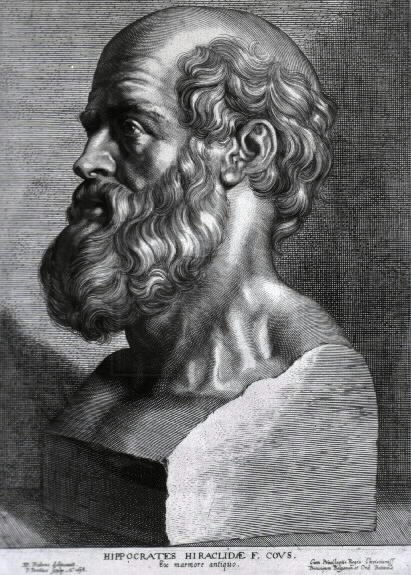
Hippocrates was born on the island of Kos probably around 460 B.C. He is often called the "father of medicine", as he founded what was at the time a truly novel practice through the introduction of groundbreaking methodology and a code of ethics. He became famous from the start of his career and throughout nearly twenty five centuries his influence was to medical thinking what Aristotle's was to philosophy.

Having learned medicine from his father Heraclides who was a physician-priest at the Asclepeion of Kos, he later studied at the Knidian school of medicine, but refused to adopt their theories. He was renown for his pragmatic approach to medicine. He separated the discipline of medicine from religion, and relied on clinical signs and logical conclusions to identify and treat sickness.

Hippocrates Kos Greece
Hippocrates, engraving by Peter Paul Rubens, 1638.
Courtesy of the 
National Library of Medicine
"Men believe only that it is a divine disease because of their ignorance and amazement." (The Sacred Disease).

He founded the Hippocratic school of medicine (around 430 B.C.) and established medicine as a distinct discipline, thereby creating the medical profession. Many documents, including the Hippocratic Oath and a collection of around 60 works in Greek referred to since ancient times as the Hippocratic Corpus are attributed to Hippocrates and his disciples.  The contents are so varied that historians believe that they constitute the remains of a collection of books from a library in Kos or Alexandria. In truth, only a fraction of the Hippocratic works have survived as witnessed by references in existing treatises while many only exist in their translation in Hebrew, Syriac, Arabic or Latin.

Two distinct schools of Medicine actually opposed each other in those times. While the Hippocratic school adopted more of a generalist approach focusing mainly on the patient as a coherent integrated whole, the Knidian school concentrated on specific areas and organs of the body, seeking to identify and classify the different kinds of disease. The Hippocratic school was in practice more efficient with its general diagnosis and its passive treatments thereby gaining the upper hand in the debate between the two sides. 

Hippocrates was influenced by the Pythagorean theory whereby Nature is a combination of four elements (water, earth, wind and fire) and by applying this concept to medicine he conceived the  four humors (blood, phlegm, yellow bile and black bile). Health is a state due to the harmonious coexistence of the four humors while any disharmony or imbalance would be the cause of a disease. 

Hippocrates was a strong proponent of strengthening one's body in order to bolster its resistance levels. He also insisted on strict dietary measures in dealing with illness. By establishing this holistic approach he was led to concentrate on the patient rather than the disease.

Herbs and healing plants were studied systematically (around 380 can be found in the Hippocratic Corpus including thyme, sage, mint, fennel, garlic...) and were prescribed to reestablish the equilibrium between the humors. 

Hippocrates acknowledged the need for professionalism and discipline in the exercise of the medical profession. He encouraged the recording of medicinal methods and findings (what we now call "clinical observations") in a clear and objective manner, in order to aid fellow physicians in their diagnosis and their forecast of the evolution of the disease. He took regular note of many symptoms including complexion, pulse, fever, pains, movement and excretions. A number of  medical conditions were first described by Hippocrates and his disciples, such as the clubbing of the fingers (often referred to as "Hippocratic fingers") as well as a number of lung diseases and ailments of the rectum.

Hippocrates taught and practiced medicine throughout his life, traveled to many places, and exchanged ideas with other schools of thought. He reputedly lectured his students under the plane tree which is currently in Lotzia square in Kos Town. He died at a ripe old age in the town of Larissa in Thessaly around 370 B.C.

Even though his work in the field of medicine has in some respects become obsolete, his contribution to scientific progress has been monumental.

The Aubergines that become Moussaka


Aubergines are one of the most abundant vegetables produced on the island of Kos because they are available throughout the summer and the climate favors them. The actual plant is around 40cm to 1.50m tall, has a spiny stem, and produces a white flower. The leaves are large and coarse.
These large, firm dark purple skinned vegetables have a spongy flesh and are somewhat bitter when eaten raw but become rather tender when cooked and have become a major ingredient of Mediterranean cuisine and more specifically Greek cuisine. They are cooked in a multitude of ways, the simplest being just grilled or fried (traditionally accompanied by some garlic sauce), while the “Melitzanosalata” i.e. the aubergine salad (the aubergines are grilled, then skinned and deseeded, and finally mashed and mixed with some olive oil) the papoutsakia (fried aubergines with béchamel, minced meat and cheese) and the classic Moussaka are some of the more popular dishes. All of these recipes are available in most traditional restaurants especially during the summer months.


jg. Powered by Blogger.